Thursday, February 21, 2013


The Great Gold Deception and Misdirection
Published : February 20th, 2013

“Fascism should more properly be called corporatism, because it is the merger of state and corporate power.” 
Benito Mussolini

It would be fortunate for the western world, particularly the United States, if it were “merely” becoming a neo-fascist dictatorship. But since all life forces evolve, particularly those that are evil, the west is actually experiencing something far more pernicious: namely, a banksterist dictatorship, which is en route to something even worse.

In Banksterism, the full arsenal of the state is deployed to preserve and protect one thing above all else: the power, wealth, influence and profits of banksters. It is only the crumbs left over after the banksters have gorged themselves at the moneytrough that are cast upon the dirt for everyone else to scavenge and peck upon. The problem is that history, and particularly recent history shows that banksters can never get enough. They are addicted to lucre, as if it were heroin. So in a banksteristdictatorship, capital is systematically plundered from the overall economy, causing it to weaken, and then die. This is when the covert totalitarianism of banksterism yields to overt, full-blown, state-sponsored military totalitarianism, better known as the Police State. The road to tyranny is paved with banksterism.

The week of February 11, 2013 saw one of the most persistent, concentrated and vicious attacks on precious metals prices during the entire GENERATION -longbankster-orchestrated price rigging campaign. Prices suffered repeated, waterfall declines every single day, and often multiple times per day, on precisely zero news that might have explained them. In other words, these price raids were outright, collusive and pre-meditated slaughters, conducted one after another after another. As financial market experts know, such price action is totally unnatural and illogical; no legitimate, for-profit seller in their right mind dumps supply onto a market in this fashion, unless they know for a fact that their price raid will work, and continue to work. This is the case when the price manipulator controls the market. While we are told that price fixing is illegal, this is obviously false because certain well-connected elites get away with it whenever they want, and for decades at a time. If a cabal can manipulate a large, global market such as gold, it can steal staggering sums of money.

Based on the elephantine, concentrated short positions in gold and silver held last week by the top eight cartel members, it is probable that they raked in profits of more than $1,000,000,000 (one billion dollars) in the gold futures market, and more than $450,000,000 (four hundred fifty million dollars) in the silver futures market price attacks. In total, they swindled nearly $1.5 billion dollars, in gold and silver futures alone, in one week alone, in the United States alone, by pushing a few computer keys and capturing the right regulators, who are trained and incentivized to look the other way. While zero true economic value was created by these price manipulations, $1,500,000,000.00 (1.5 billion dollars) flowed from the marketplace and into the already stuffed pockets of enormously powerful and well-connectedbanksters. This is the banksterist dictatorship right in the people’s face and flipping the bird at them. If you were long the metals last week, you learned who was in charge, and it wasn’t you, no matter how intelligent the investment rationale behind your position might have been.

The $1.5 billion profit figure does not include additional shorting profits that were likely made in more opaque instruments such as options, futures on options and other synthetic derivatives. Nor does it include profits that were likely engineered in international metals markets, such as Tokyo, Sydney, Zurich, London, and theCaymen Islands. Nor does it include what must have been far greater profits derived from the shorting and naked shorting of mining equities, and the purchase of mining equity puts. All in all, the price rigging cartel surely made multiples of their $1.5 billion futures market windfall.

For years, the explanation and faux-justification for the United States-centered price oppression of precious metals has been that it is a government-directed operation designed to protect a monopoly product vital to the nation and the world: the United States dollar, the world’s sole, current reserve currency. We are led to believe that the banks supposedly working in concert with the United States Treasury and Federal Reserve to support the dollar by shorting its reciprocals, gold and silver, are somehow doing “God’s work.” It is a touching Motherhood and Apple Pie tale, dripping with overtones of Red, White and Blue patriotism. Unfortunately, it is a total deception.

Kyle Bass, the credible, successful and well-respected fund manager, recently reported that a senior White House official informed him that the way the United States government intends to revive the moribund economy is to promote exports, and that in order to achieve this objective, the government intends to allow the dollar to decline, significantly. Indeed, the press is now awash in stories about the so-called “currency wars” that are now said to rage worldwide. 

But this can hardly be called news, because a weak currency is already guaranteed in a country that is bankrupt. Currency momentum can only last so long, even for so-called King Dollar. The United States currently has debt and unfunded contingent liabilities exceeding $200,000,000,000,000.00 (two hundred trillion dollars); the nation’s annual, federal cash deficit  has hovered around $1,000,000,000,000.00 (one trillion dollars) for four years, is stuck, and does not include state, county or municipal deficits; the nation’s federal GAAP deficits have exceeded $5,000,000,000,000.00 (five trillion dollars) for four years, and are also stuck; state and local government employee unfunded pension obligations exceed $3,500,000,000,000.00 (three and one half trillion dollars), despite a Federal Reserve-engineered and totally artificial price levitation of the stock market; and the long, sharp deficit horns of Obamacare, which no one in Congress even read before passing and the negative fiscal implications of which are completely and utterly incomprehensible to anyone and everyone other than God,  are now starting to rip into economic and fiscal reality and tear it to shreds. Obamacare will unquestionably become a multi-trillion dollar deficit catastrophe, on top of all the others. So any commentary about a “strong dollar policy” should be restricted to two venues, only: Comedy Central; and the jackass cages at zoos.

But now we have a contradiction. One the one hand, we are told that the government smashes precious metals prices in order to prop up the value of the dollar. On the other hand, we learn that the government intends to trash the dollar, in an effort to jump start the dying economy through export growth. Which is it then, and what does the government really want? If they want a strong dollar (which we just demonstrated they cannot have even if they do want it, which they don’t), then yes, suppressing metals prices might be a useful, temporary gimmick. If they want a weak dollar, then they should leave metals prices alone and allow them to find their true market levels. There is no possible way that the United States, with $200,000,000,000,000.00 in debts and unfunded obligations, chronic trade deficits, and a shrinking economy could seriously want a strong dollar; that would be a vote for economic self-destruction.

So while the explanation that precious metals prices are being artificially depressed to support the dollar sounds logical and patriotic, it has actually been a calculated and clever misdirection. In misdirection, observers are told to look to the left, while the real action takes place to the right. Another word for misdirection is “sting.” 

Like Hemingway’s saying about how one goes bankrupt, in a sting, the victims (or “marks”) learn slowly, and then all at once. By the time the “all at once” learning phase has occurred, the marks’ “investments” are long gone. The thieves who stung the victims will be traveling at break neck speed 100 miles ahead of the marks, and the marks will never catch up. The 30+ year precious metals price manipulation has been a generation-long sting that is still going on. In a way, you have to hand it to these criminals; they have taken greed and shamelessness to a whole new, intergalactic dimension.

The fatal flaw in the “God’s work” narrative that has accompanied the precious metals price rigging crime is that it assumes the government is in charge. But in abanksterist dictatorship, that is not how it works: governments do not control banks; banks control governments.

As we are taught by Occam’s Razor, all things being equal, the simplest explanation is likely to be the truth. And when it comes to the bankster-controlled precious metals price fixing sting, the Razor cuts right to the core of the matter. The real reason for the persistent price rigging of precious metals prices is simple:  Money. For the past 30+ years, the banksters have enjoyed an outright license to print profits in the metals markets, and they have leveraged that license to make tens, if not hundreds of billions of dollars in the process.

In banksterism, it is not the government that prints the money, but rather thebanksters who print the money, and once it is printed, they hand it to themselves. The irony is that they use the government’s printing presses and computers, apparently to keep costs low and boost returns. One problem with the banksterlicense to print profits is that in zero-sum markets, such as futures, bankster gains must by definition be stolen from the victims on the other side of the trades, resulting in serious harm to others. But far worse, the bankster license to print is simultaneously a license to kill an economy. 

Bankster-orchestrated precious metals price rigging represents the longest-running public theft in history. It is 100% aided and abetted by the United States government and others, including Britain’s. The legions of regulators in these jurisdictions, who have sworn oaths to enforce laws and prosecute fraud and who are clearly aware of the problem, have done precisely nothing to stop it. The only thing changing today is that the fraud is getting even more brazen, endemic and profitable.

The price of this massive crime against the society of the United States and the nation’s economy is literally impossible to overstate.

First, by routinely crashing gold and silver paper prices for private gain, thebanksters have given economic competitors such as China and Russia the ability to acquire massive amounts of gold at bargain basement prices. This is occurring at a time when dozens of countries are expressing open disdain for the dollar reserve currency regime, and actively working to subvert it. When the banksterist price manipulation scheme ultimately fails, as such schemes always do, metals prices will surge to their true levels, giving countries such as China epic windfall profits. China’s rapidly increased wealth, combined with its new found ability to back the yuan with gold will pole vault their currency into quasi- or full-reserve status, particularly among key trading partners. In monetary terms, this will be the equivalent of a 9.0 earthquake for the United States, particularly since it could happen suddenly. A matter as serious as this is one of national security. 

Second, the demonstrable bankster greed that has been the foundation of the precious metals price rigging scandal makes it likely, if not virtually certain that another greed-fueled scandal has also been playing out in the shadows: namely, that the United States’s official gold reserves have been leased out to banksters in exchange for pittance interest payments, and then sold to the Chinese and others, for profit.  Further, given that the banksters know for a FACT that metals prices are far below market, since it is they, the banksters that have collusively fixed them there, we have to wonder if a serious portion of the official U.S. reserves have not been appropriated by the banksters, at dirt cheap prices at best, or maybe simply in exchange for pieces of paper called “Leases,” at worst. In a banksterist dictatorship, this kind of thing can happen without anyone on the outside knowing about it, or anyone on the inside saying a word. 

If, in the future, the banksters claim that they cannot return the gold, nothing will happen to them, because in banksterism, the government is captured and controlled by the banksters. Further, in banksterism, the people are brainwashed to believe that the banks are “too big to touch,” in other words, “too big to prosecute.” People are fearwashed (a form of brainwashing and mind control) to believe that prosecutingbanksters will “bring down the economy.” This kind of propaganda is the height of irony, because it is actually banksterism itself that destroys an economy. 

There already exists a mound of evidence indicating that the United States gold reserve is gone, either in whole or in part. This evidence ranges from the persistent refusal by the government to even audit its supposed stockpile, to the snail’s-pace proposed return of Germany’s gold. If Germany wants its gold returned from the New York Fed, why must they wait seven years to get only a small fraction of it? 

Third, flagrant, unprosecuted corruption causes people to lose faith in government and its institutions, particularly those related to justice. People come to realize that if a nation’s monetary and banking systems are corrupt, then such corruption likely filters into other vital areas of government. Since money and banking constitute the core of a so-called capitalistic economy, the corruption of these functions is crippling.

The paradox is that by trying to discredit gold, the banksters actually discredit the dollar by sewing suspicions and concerns about its value. People will ask themselves, “If the only way the U.S. government can create the illusion of dollar strength is by illegally manipulating the prices of its reciprocals, gold and silver, then the dollar itself must be in trouble.” If the dollar were intrinsically sound, it would not be necessary to illegally and artificially support it via price manipulations and fraud. More, people will start to realize what is truly going on: a banksterist, double-standard regime, in which there is total freedom for the banksters to plunder and to print profits at will; and a strict set of laws and regulations for everyone else, punishable by everything from draconian fines to prison terms.

Ayn Rand described this phenomenon well when she wrote: “We are fast approaching the stage of ultimate inversion: the stage where the government is free to do anything it pleases, while citizens may act only by permission; which is the stage of the darkest periods of human history, the stage of rule by brute force.” Just substitute the word “banksters” for “government” to get a true read of today’s situation.

Fourth, as with socialism, fascism and communism, banksterism is guaranteed to fail, and will destroy an entire economy in the process. While the small elite will become enormously wealthy during the reign of any of these “isms,” it becomes so at the expense of the remainder of society. This is exactly what has been happening since the 2008 meltdown, when despite trillions of dollars’ worth of direct aid forbanksters, the true economy continues to deteriorate. This deterioration would be even more obvious if inflation were properly reported, as it would become clear that GDP is in structural decline. Predictably, bankster profits have increased throughout the ongoing financial crisis, while the poverty level in the United States has exploded, incomes have eroded, the middle class has been destroyed and the real economy has contracted. This type of dynamic is inevitable in a banksterist dictatorship, because as capital is continuously looted from the economy, true economic recovery becomes impossible.

Fifth, by smashing metals prices, the banksters have frightened ordinary people away from metals investments, and this is no doubt an intended and desired outcome, at least from the government’s perspective. The government wants people to spend, not save; it wants them to be poor, not rich; it wants them dependent, not free. When the inevitable crisis occurs, those who have not diversified their savings into metals will have nothing but rapidly depreciating pieces of paper called dollars, which have zero intrinsic worth. Because their assets will be trapped in dollars, they will be lost. In a banksterist dictatorship, the people are encouraged, and ultimately forced to commit financial suicide by directing their money into idiotic stock market and similar “investments,” as they desperately search for yield and capital gains. It is no coincidence that the banksters get to earn fees from these desperation transactions. Such mal-investments will ultimately implode, ruining investors. Governments know for a fact that it is easy to control people who are completely helpless and financially dead.

The recent surge of gun purchases by citizens demonstrates that there is a deep understanding among them about what is happening, and coming. While many have been conned into worshipping at the altar of Bernankeism, and are buying stocks in a market that only goes up thanks to desperate and deliberate Fed intervention, countless others have gone to the gun stores instead. This is known as Voting with one’s Wallet, and the American wallet can actually be quite smart in times of chaos. Those who have discounted the collective intelligence of the American people have always lived to regret it. 

Combined, the cost of the precious metals price fixing scandal has been incalculable for the United States economy and people. People worry about nuclear bombs, but the fallout from nuclear stupidity can be far more deadly. The fact that the bankstershave had free reign to perpetrate their fraud for more than three decades represents nuclear stupidity of an epic magnitude. The fallout of this nuclear stupidity is so dangerous that it has undermined the prospects of an entire nation, and possibly made inevitable the country’s ruin. The vast enrichment of the Chinese, at the same time that the United States is attempting to deal with its national bankruptcy and structurally faltering economy is a potentially explosive scenario with zero upside and enormous downside prospects for America.

In conclusion, for those concerned about what has been happening to precious metals prices, the following summary might provide some helpful context, and even consolation. Those of you who have chosen to denominate some portion of your wealth in precious metals have not been intellectually wrong; you have just been cheated, at least for now. To summarize: 

1) The precious metals price rigging campaign that has taken place for the past 30+ years has been a simple, blatant, obvious crime.

2) This crime has been orchestrated by banksters for one purpose only: to make money. The money they have made has not come out of thin air; it has been stolen from people on the other side of the respective trades. Therefore, it is a crime scene strewn with real victims. The fuel for this crime has been the diagnosable mental illness called Greed.

3) This crime has not had one redeeming virtue, patriotic or otherwise. It has not in any way had anything to do with helping to “defend” the dollar or aid the United States or its people. It has only been about money, and greed.

4) This crime has created enormous threats to the United States economy, the dollar, and national security. 

5) This crime has set the stage for the vast enrichment of powerful economic competitors, such as China and Russia. 

6) By financially empowering the nation’s competitors, it will also empower them militarily, so the ruinous consequences of this crime are unpredictable, immeasurable and stark.

7) The road to tyranny is paved with banksterism, which is a supreme threat to citizens worldwide.

8) While smart nations such as China encourage their citizens to buy gold and silver, stupid nations such as the United States discourage gold ownership via metals price manipulation, and instead encourage spending on consumer products that ultimately impoverish citizens. When metals prices are revalued, which is absolutely inevitable, China’s citizens and government will gain, while America’s citizens and government will lose. This is a consequence of nuclear stupidity.

9) Greed is the seed of its own destruction, and price manipulations always fail in time. When the precious metals price manipulation fails, prices will surge from current depressed levels. 

10) Ultimately, the truth will come out about the status of the United States gold reserve, and it is likely to be shocking. If the U.S. gold reserve has in fact been sold, for example to the Chinese, and/or appropriated by the banksters, the consequences for the United States economy and dollar will be dire and irreversible. The United States could become the equivalent of a third world nation virtually overnight, with staggering inflation, violent social unrest, exploding poverty, surging homelessness, and unprecedented hunger. Such news would outright guarantee the swift emergence of uncontrolled totalitarianism that would make previous historic episodes of this curse in countries such as the USSR and Germany look tame.

11) Readers should contact their elected representatives and ask why “too big to fail, and too big to touch” banks, that have been and continue to be backstopped by the American taxpayer, are allowed to speculate in the futures casino with tens to hundreds of billions of dollars. If these banksters lose, who pays? The taxpayer, obviously, but why is such insanity permitted to continue?

12) Readers should also ask their representatives, “Where is our gold? Do we still have any? How, Mr. or Ms. Elected Representative, do you know? If it is gone, who got it? And how much did they pay for it? Anything, or did they just give our government a piece of paper called a “Lease”? Why is the status of the people’s gold a state secret? How do you justify that, Mr. or Ms. Elected Representative? If you lie about our, the people’s gold, what else are you lying about? Is it, in fact, everything?

The End Game is coming. It is inevitable, despite official pronouncements to the contrary. Just look at the numbers. They do not lie. It is urgent that you take steps right now to protect not just your financial freedom, but your personal freedom as well.

Thursday, February 14, 2013

Global central banks have collectively "printed" over $11 TRILLION...WHY WOULD YOU SELL YOUR SILVER AND GOLD?


The State of the Dollar

Editorial of The New York Sun | February 11, 2013

All eyes will be on President Obama [tomorrow] when he fulfills his constitutional obligation to “give to the Congress Information of the State of the Union, and recommend to their Consideration such Measures as he shall judge necessary and expedient.” All sorts of topics are in the advance headlines, from jobs, to the budget crisis, to gay rights, to the war. All of them are worthy of attention by the President and the Congress.

Yet we haven’t seen in the headlines about the pending presidential palaver even one mention of the topic that, by our lights, rises above all the others. This is the state of the dollar. Particularly in an age of fiat money, where there is no gold or silver backing for our national currency and the only basis of it is the economic good fortune of the nation, well, particularly in such an age, the state of the dollar can be seen as a proxy for the state of the union itself.

If so, the state of the union is at a historic low. We have rehearsed this point so often in these columns that we fear our loyal readers are in danger of becoming afflicted with monetary monotony. We run the risk because of the aphorism of the Robert L. Bartley, now sadly deceased. “It takes 75 editorials to pass a law,” he said. He was speaking of a newspaper that had a daily circulation of 2 million copies. Imagine how many editorials it will take from us more modest sized newspapers.

This topic happens to be getting hotter by the week. The biggest development of late, in our book, was the decision of the Wall Street Journal to issue the op-ed piece by John Taylor warning that the supposedly stimulative monetary policy that Chairman Bernanke and his colleagues have been running is actually a drag on the recovery. That would be like a fire department discovering that the water with which it is hosing down a blaze is flammable.

So what in the world does the President think of monetary policy? Why has he been so all-fired mum on the subject? The question nags at us, particularly in light of his comments during the 2008 campaign. He made them in a meeting with the editors of the Sentinel, a newspaper that is issued at Keene, New Hampshire. We wrote about Mr. Obama’s comments in 2011, when the value of the dollar collapsed to below a 1,500th of an ounce of gold.

The question that had been put to Mr. Obama in 2008 — it was perfectly asked by the Sentinel's editor, Jim Rousmaniere — was about the decline of the dollar. “Is that good or bad?” the candidate was asked. Mr. Obama tried briefly to suggest that there were some benefits to a weak dollar, but he was too smart to stick with that argument — at least while he was running for office. The last guy who tried it was a certain peanut farmer who was trying for a second term.

Then Mr. Obama noted that we hadn’t seen inflation — yet. “It’s not going to last forever,” he said. “So the downside is we’re going to see inflationary pressures as a consequence of this.” Then the candidate asserted that he was “less concerned” about the day to day gyrations of the dollar than “by the underlying economic fundamentals that are causing the dollar to decline,” which he characterized as “that we’re spending more than we produce, and you know we are losing our competitive edge.”

So how’s that working out now that Mr. Obama is beginning his second term? The Federal Reserve has expanded its balance sheet to levels it would once have been hard even to dream about. Our central bank is exposed, as George Melloan wrote in a column in these pages called “The Fed’s Worst Fear,” to the bond market. More than a dozen states are eying making gold and silver coins legal tender. A vast bi-partisan majority of the House wants to audit the Fed, and a new avant garde is talking about the gold standard. Isn’t it past time for the President to say something to the Congress and to the American people about the state of the dollar?

http://www.nysun.com/editorials/the-state-of-the-dollar/88190/
____________________________

Obama's Treasury Pick Says He Supports Strong U.S. Dollar
From Reuters
Wednesday, February 13, 2013
WASHINGTON -- Jack Lew, President Barack Obama's pick to run the Treasury Department, on Wednesday said he would support a strong U.S. dollar, in line with longstanding U.S. policy.
"Treasury has had a longstanding provision through administrations of both parties that a strong dollar is in the best interests of promoting U.S. growth, productivity and competitiveness," Lew said during a hearing vetting him for Treasury secretary, in response to a question.
"If confirmed, I would not change that policy."
____________________________
But just how is the 'strong dollar' policy implemented, except by suppressing gold?  Nobody in political authority or journalism ever asks.  Is it implemented at the end of the barrel of a gun, or perhaps with a smart bomb or maybe a drone strike?
____________________________

For an example of "dumb Dollar policy" please refer to comments by then Fed Governor Ben S. Bernanke:


Remarks by Governor Ben S. Bernanke
Before the National Economists Club, Washington, D.C. 
November 21, 2002
Deflation: Making Sure "It" Doesn’t Happen Here
Since World War II, inflation–the apparently inexorable rise in the prices of goods and services–has been the bane of central bankers. Economists of various stripes have argued that inflation is the inevitable result of (pick your favorite) the abandonment of metallic monetary standards, a lack of fiscal discipline, shocks to the price of oil and other commodities, struggles over the distribution of income, excessive money creation, self-confirming inflation expectations, an "inflation bias" in the policies of central banks, and still others. Despite widespread "inflation pessimism," however, during the 1980s and 1990s most industrial-country central banks were able to cage, if not entirely tame, the inflation dragon. Although a number of factors converged to make this happy outcome possible, an essential element was the heightened understanding by central bankers and, equally as important, by political leaders and the public at large of the very high costs of allowing the economy to stray too far from price stability.
With inflation rates now quite low in the United States, however, some have expressed concern that we may soon face a new problem–the danger of deflation, or falling prices. That this concern is not purely hypothetical is brought home to us whenever we read newspaper reports about Japan, where what seems to be a relatively moderate deflation–a decline in consumer prices of about 1 percent per year–has been associated with years of painfully slow growth, rising joblessness, and apparently intractable financial problems in the banking and corporate sectors. While it is difficult to sort out cause from effect, the consensus view is that deflation has been an important negative factor in the Japanese slump.
So, is deflation a threat to the economic health of the United States? Not to leave you in suspense, I believe that the chance of significant deflation in the United States in the foreseeable future is extremely small, for two principal reasons. The first is the resilience and structural stability of the U.S. economy itself. Over the years, the U.S. economy has shown a remarkable ability to absorb shocks of all kinds, to recover, and to continue to grow. Flexible and efficient markets for labor and capital, an entrepreneurial tradition, and a general willingness to tolerate and even embrace technological and economic change all contribute to this resiliency. A particularly important protective factor in the current environment is the strength of our financial system: Despite the adverse shocks of the past year, our banking system remains healthy and well-regulated, and firm and household balance sheets are for the most part in good shape. Also helpful is that inflation has recently been not only low but quite stable, with one result being that inflation expectations seem well anchored. For example, according to the University of Michigan survey that underlies the index of consumer sentiment, the median expected rate of inflation during the next five to ten years among those interviewed was 2.9 percent in October 2002, as compared with 2.7 percent a year earlier and 3.0 percent two years earlier–a stable record indeed.
The second bulwark against deflation in the United States, and the one that will be the focus of my remarks today, is the Federal Reserve System itself. The Congress has given the Fed the responsibility of preserving price stability (among other objectives), which most definitely implies avoiding deflation as well as inflation. I am confident that the Fed would take whatever means necessary to prevent significant deflation in the United States and, moreover, that the U.S. central bank, in cooperation with other parts of the government as needed, has sufficient policy instruments to ensure that any deflation that might occur would be both mild and brief.
Of course, we must take care lest confidence become over-confidence. Deflationary episodes are rare, and generalization about them is difficult. Indeed, a recent Federal Reserve study of the Japanese experience concluded that the deflation there was almost entirely unexpected, by both foreign and Japanese observers alike (Ahearne et al., 2002). So, having said that deflation in the United States is highly unlikely, I would be imprudent to rule out the possibility altogether. Accordingly, I want to turn to a further exploration of the causes of deflation, its economic effects, and the policy instruments that can be deployed against it. Before going further I should say that my comments today reflect my own views only and are not necessarily those of my colleagues on the Board of Governors or the Federal Open Market Committee.
Deflation: Its Causes and Effects
Deflation is defined as a general decline in prices, with emphasis on the word "general." At any given time, especially in a low-inflation economy like that of our recent experience, prices of some goods and services will be falling. Price declines in a specific sector may occur because productivity is rising and costs are falling more quickly in that sector than elsewhere or because the demand for the output of that sector is weak relative to the demand for other goods and services. Sector-specific price declines, uncomfortable as they may be for producers in that sector, are generally not a problem for the economy as a whole and do not constitute deflation. Deflation per se occurs only when price declines are so widespread that broad-based indexes of prices, such as the consumer price index, register ongoing declines.
The sources of deflation are not a mystery. Deflation is in almost all cases a side effect of a collapse of aggregate demand–a drop in spending so severe that producers must cut prices on an ongoing basis in order to find buyers.1 Likewise, the economic effects of a deflationary episode, for the most part, are similar to those of any other sharp decline in aggregate spending–namely, recession, rising unemployment, and financial stress.
However, a deflationary recession may differ in one respect from "normal" recessions in which the inflation rate is at least modestly positive: Deflation of sufficient magnitude may result in the nominal interest rate declining to zero or very close to zero.2 Once the nominal interest rate is at zero, no further downward adjustment in the rate can occur, since lenders generally will not accept a negative nominal interest rate when it is possible instead to hold cash. At this point, the nominal interest rate is said to have hit the "zero bound."
_______________________________

Why Fed Policy Is Hurting The Economy


John Taylor wrote a very interesting article in the Wall Street Journal last week, "Fed Policy Is a Drag on the Economy," in which he argues that the Fed has been hurting the economy by keeping short-term interest rates extremely low, and promising to keep them extremely low for a long time. This of course runs directly counter to what we have been led to believe.
He describes a variety of problems created by super-easy monetary policy (e.g., encouraging people to take on too much risk, creating great uncertainty about the Fed's ability to reverse its QE efforts, making it easy for the federal government to fund its massive spending plans, and forcing other central banks to follow suit). More importantly, perhaps, he argues that very low interest rates create disincentives to save, and this limits the economy's ability to grow. "While borrowers might like a near-zero rate, there is little incentive for lenders to extend credit at that rate. ... lenders supply less credit at the lower rate. The decline in credit availability reduces aggregate demand, which tends to increase unemployment, a classic unintended consequence of the policy."
In other words, while everyone, including the Fed, thinks that ultra low interest rates provide an important source of stimulus to the economy, it's quite likely that they do just the opposite. The Law of Unintended Consequences strikes yet again.
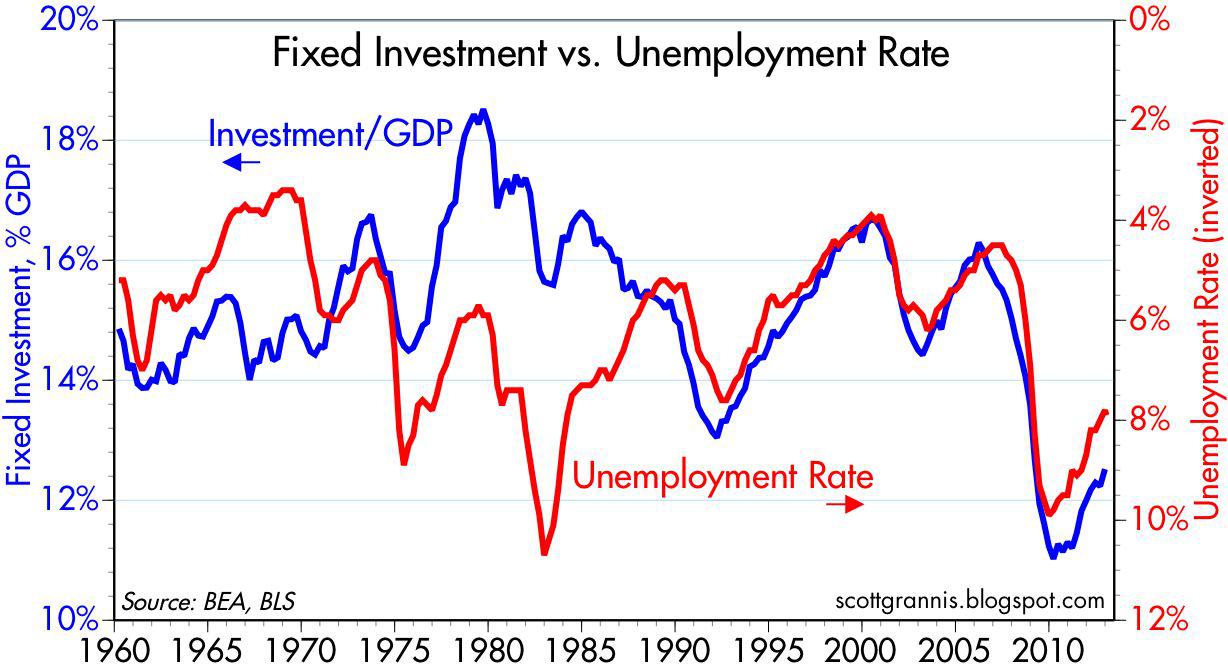
Taylor had a somewhat-related blog post the other day in which he discusses the "strong inverse relationship between fixed investment and the unemployment rate." He accompanied the post with a chart that got my attention, because I saw a way to improve it.
(click to enlarge)
The above chart uses the same data as Taylor's original chart, but includes data going back to 1960 (his only went back to 1990). The interpretation of the chart remains the same. There is a strong inverse relationship between fixed investment as a share of GDP (fixed investment includes private residential and nonresidential construction, and private investment in equipment and software) and the unemployment rate, which is a good proxy for the health of the economy. He is careful to note that while the correlation is strong, we cannot infer the direction of causality. But this does illustrate how a lack of investment could go a long way to explaining why the recovery has been so weak.
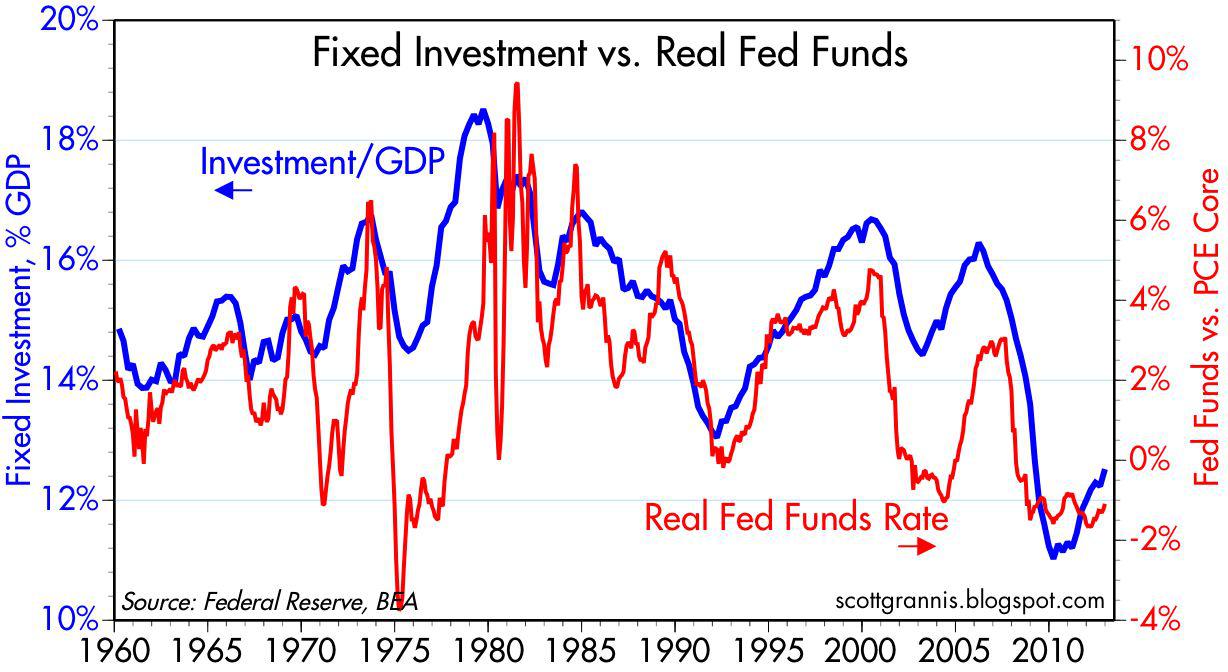
It then occurred to me to put his two ideas together, to see if the Fed's monetary policy was correlated with the amount of fixed investment. Where Taylor's WSJ article focuses on how artificially low interest rates limit lending and therefore aggregate demand, and his chart compares fixed investment to the unemployment rate, I wanted to see if there was a link between Fed policy and fixed investment.
(click to enlarge)
As the chart above shows, Fed policy is indeed highly correlated to fixed investment (even more so than the unemployment rate is). This fits hand in glove with the first chart, which links fixed investment to the unemployment rate. The red line in the above chart is the real Federal funds rate (using the Core PCE deflator), since that is a good proxy for the degree to which monetary policy is "tight" or "easy."
This puts some meat on the bones of Taylor's WSJ article. The Fed's unusually accommodative monetary policy stance -- which promises extremely low interest rates (negative in real terms) for a long time to come -- does appear to be a factor in limiting the amount of funds available for investment, and in reducing aggregate demand. And that in turn helps to explain why the recovery has been so weak.
How else to explain the fact that fixed investment is almost always very strong when monetary policy is very tight, and weak when monetary policy is easy? How else to explain how a decade of extremely low interest rates have failed to stimulate Japan's economy?
Food for thought and controversy.
____________________________

Occam's Gold vs Rube Goldberg's Fiat

Tyler Durden's picture


From the 'simplicity' of a Gold Standard to the 'complexity' of our current fiat system, Santiago Capital draws a handy analogy between the over-complicated machines of 'Rube Goldberg' that represents the interactions between the various actors affecting the size and velocity of our monetary base and the 'simplest possible, but no simpler' world of 'Occam's Razor'-prone gold. In two brief presentations, Brent Johnson introduces the two systems and explains that in order to keep the shark of our economy alive, one of two things must happen: monetary velocity must be maintained or the monetary base must rise. Obviously both are inflationary. From how the system is designed to its drastic implications, simple, brief, concise, and what to do about it.
____________________________
Global central banks have "printed" over $11 TRILLION collectively since the financial crisis began in 2008.  We have been lead to believe that this was necessary to "get the global economy growing again".      I guess not:

Futures Slump As Global Q4 GDPs Dump

Tyler Durden's picture


It started overnight in Japan, where Q4 GDP posted a surprising and disappointing 3rd quarter of declines, then quickly spread to France, whose Q4 GDP declined -0.3% Q/Q missing expectations of a -0.2% drop, down from a +0.1% increase, then Germany, whose GDP also missed expectations of a -0.5% drop, declining from a +0.2% increase to a -0.6% drop, then on to Italy (-0.9% vs Exp. -0.6%, last -0.2%), Portugal (-1.8%, Exp. -1.0%, last -0.9%), Greece (down -6.0%, previously -6.7%), Hungary (-0.9%, Exp. -0.3%), Austria (-0.2%, down from 0.1%), Cyprus (-3.1%, last -2.0%), and so on.
____________________________
WHO IN THEIR RIGHT MIND WOULD BE SELLING THEIR PHYSICAL GOLD AND SILVER AT A DARK TIME LIKE THIS?

Wednesday, February 13, 2013

U.S. Gold Is Being Exported To Asia, Especially Hong Kong

The US reportedly exported $4 billion in NON-MONETARY gold in December and $36 billion for the year.  That is 22 million ounces of exports or so for the year. The US produces 8 million ounces a year .

Where did the 14 million ounce difference come from?

Is the Federal Reserve giving all of our Gold away?

U.S. Gold Bars and Coins Find New Home Overseas on Asian Demand
By Frank Tang
Reuters
Monday, February 11, 2013
NEW YORK -- Booming demand for gold as a store of wealth among Asian investors is driving physical gold bars and coins out of the United States and into Asia.

A growing number of gold vaults for affluent Asians and new precious metals investment products, particularly exchange-traded funds, have led to an exodus of gold owned privately from the United States into emerging economic powers such as China.

On Friday, Commerce Department data showed U.S. exports of nonmonetary gold, which excludes central bank transactions, soared by 43 percent to $4 billion in December from the previous month.

That's the highest total and the biggest month-on-month jump in U.S. private gold exports since September 2011, when gold rallied to a record high over $1,920 an ounce. Prices are currently about 14 percent below the peak at $1,643 per ounce.
Hong Kong accounted for around $2 billion, or half of the nonmonetary gold exports for the month.

Uncertainty about the U.S. fiscal situation and euro-zone debt crisis have prompted many ultra-rich gold investors to move their bullion holdings to Hong Kong and Singapore from traditional gold hubs in Switzerland, London, and New York.
"As the Asian market becomes more affluent, we are seeing more private investors looking to move their metals offshore," said Miguel Perez-Santalla, vice president of online precious-metals exchange BullionVault. "People want to have their money next to them."

A shortage of storage space has been a growing issue in Asia as vaulting companies have not kept up with the pace of inflow of physical bullion, he said.
U.S. gold exports to Hong Kong have been steadily increasing in the past several years as wealthy Asian individuals looked to diversify their portfolios into gold, said Michael George, a commodity specialist at the U.S. Geological Survey.
In November, ETF Securities launched three ETFs that are backed by physical precious metal in Hong Kong.

Some money managers cited the recent U.S. fiscal crisis for the physical gold outflow.

"The uncertainty over the debt ceiling and fiscal cliff have greatly diminished confidence in the U.S. banking system," said Jeffrey Sica, chief investment officer of SICA Wealth, which manages over $1 billion in client assets.
George said some of the gold import to Hong Kong could be transferred to China and nearby countries such as Taiwan, which has also seen an increase in U.S. gold imports in recent years.

Last Tuesday data showed Hong Kong's net gold flow to mainland China jumped 47 percent in 2012 to a record high of 557.478 tonnes, a sign of strong Chinese demand.

China, the world's second largest economy, has been vying with India to be the world's top gold consumer.

Gold demand from China is likely to grow around 10 percent in 2013, an official from the trade group World Gold Council said in a recent interview.
Hong Kong's proximity to the prosperous southern China and free capital-flow environment have benefited the former British colony as China's trading window to the world.

_________________________


Sprott sees scrap gold disappearing, expects Comex default


 Section: 

4p ET Monday, February 11, 2013
Dear Friend of GATA and Gold:
Sprott Asset Management CEO Eric Sprott today tells King World News that scrap gold supply is disappearing, that he expects the Comex gold futures market to default, and that when it does, gold "will make up for these past two years in no time." An excerpt from the interview is posted at the King World News blog here:
CHRIS POWELL, Secretary/Treasurer
____________________________


Russia, China and Turkey bought the most gold in 2012

Posted on 12 February 2013


The World Gold Council has released its latest list of the world’s biggest gold buyers. So who bought the most gold in the past year?

Russia, China and Turkey in that order, and India is out of the top three. Still that looks like the emerging markets hedging against a decline in the US dollar…
Video Link

_________________________


Putin's Russia Now World's Largest Gold Bullion Buyer -- Why?

Author, 'Oil and Finance: The Epic Corruption Continues'
GET UPDATES FROM Raymond J. Learsy

Posted: 02/12/2013 7:48 am

On February 10 Bloomberg reported that "Putin Turns Black Gold Into Bullion as Russia Out-Buys World," advising that the world's largest oil producer's central bank has added some 570 metric tons of gold over the last several years for a total inventory of 958 tons. This while the likes of Switzerland, France and the Netherlands were selling significant quantities of their gold holdings.

According to the article, there has been a long tradition of gold-buying/hoarding in Russian history going back to the time of Tsar Alexander II who ordered the government to start amassing gold bullion in 1867. Interestingly, the timing was almost concurrent to Russia's sale of Alaska to the United States for $7.3 million.
Yet purchases of gold under Putin have intensified to the point that Russia, as a matter of national policy and strategy, has surpassed all others in its tempo of gold accumulation. All of which then raises the question of why?

When Putin tells the central bank "to buy," does he know something that the rest of us do not or can only guess? Certainly there is Putin's predilection, which he has made generally known, that he views the U.S. as endangering the global economy by abusing the dollar. Or as Putin's political ally Evgeny Federov is quoted in the article, "The more gold a country has, the more sovereignty it will have if there is a cataclysm with the dollar, the pound or any other reserve currency."

All that certainly sounds reasonable enough given the propensity of central banks throughout the world to print their way out of the current financially orchestrated economic morass.

But is there something else in play? Some two years ago, the U.S. Commodities Futures Trading Commission fined the commodities trading house Conagra $12 million because one of its traders at the time, with but a single trade, purposely pushed the price of oil to $100/bbl for no other reason than being the first to make this historic vanity trade.
Aug 16, 2010 - U.S. Commodity Futures Trading Commission ... announced the filing and simultaneous settlement of charges against ConAgra Trade Group, ...
The trader achieved this milestone by buying a single 1,000 barrel contract on the commodities exchange, requiring a deposit of but $6,500, thereby advancing the quoted price for oil by some 25 cents/bbl to reach the first fabled $100/bbl print.
Consider that if the price of oil can be moved by a single trader, needing only some $6,500 as margin, what can be achieved on our pliable Commodity Exchanges with a trading war chest holding hundreds of millions if not billions?
In this space early last year, I wrote "Oil Embargoes, Sherlock Holmes and the Russian Butler" (02.20.2012), which touched on the importance of oil and, manifestly, its price, to Russia's economy being so deeply dependent on the revenues derived from the sale of its oil and gas. It posited the following:
We have a Russia that is governed by a coven comparable to our Wall Street "ole boys network," namely the alumni of Russia's highly touted secret service, the KGB. The KGB helped form Putin and many of his associates in government. Here was an organization that was the nonpareil master of clandestine intrigue, knowing how to keep secrets. Now in a sense, it is running the country albeit with the trappings of democratic governance.
Given the stakes at hand, would it be a real surprise that with its wealth and given the economic and strategic importance of oil revenues to Russia's well being, and with the talent at hand, that Russia is doing whatever it can to keep the price of oil high and ever higher still?
Very probably, it is not the concern of the collapse of the dollar and other reserve currencies that is motivating Putin to gobble gold, but the core knowledge that the current price of oil is a manipulated mirage aided by his minions and some day, whether sooner or later, will collapse upon itself. That the trading at the Commodity Exchanges' oil derivatives casinos, where the price of crude oil is currently pegged, is a rigged game. (please also see "The Oil Market Plays Casino While the Obama Administration Acts as Croupier" 09.10,11). Now while the going is good, and the price of oil is high, is the moment to pile in the gold because the mirage will eventually implode because it has no foundation in an unencumbered and freely traded marketplace.

http://www.huffingtonpost.com/raymond-j-learsy/putins-russia-now-worlds_b_2668286.html
_________________________


THE NUMBER ONE REASON TO OWN GOLD

____________________________


Gold Chart and Comments

traderdannorcini.blogspot.com / By Dan Norcini / Wednesday, February 13, 2013
Gold continues to work lower as it moves ever closer to a region that has heretofore provided substantial buying support. Bears are attempting to take it down through this support region in the hope of picking off the rather large contingent of sell stops sitting just under the market.
It should be noted that they have strategically used the Chinese Lunar New Year holiday week to press their case. Without that strong physical offtake, speculators on the Comex have lost an important ally. It will be interesting to see what happens next week when that period in China is finished.
By then however, it may be too late for the bulls. This market looks heavy to me. Note that on the technical chart, one of the indicators that I still use ( it is dated but still a very good tool) shows that the ADX of the Directional Movement Indicator is beginning to turn up from a very low level. A rising ADX (the dark line) is a sign that a market is in a TRENDING PHASE. So far, gold has been in a sideways consolidation pattern or range trade. That is evident from both the price action which has been confined between $1695-$1700 on the top and $1640 or so on the bottom. Along with that, the ADX has been falling which is indicative of a market in such a pattern.
________________________________
Givin It All Away -BTO

Monday, February 11, 2013

All Wars Are Bankers' Wars


I know I have, on occasion, expressed my sincere belief that the root of ALL EVIL lies in the World's banks, and primarily the US Federal Reserve. I have also said more than once that "unless, and until, ALL the people of the World tell the banks to "f**k off", NOTHING will be as it should be. ...and I honestly believe that "the life we have known" for the past 40 years is nothing more than a lie we have told ourselves in subservience to "the banks" as quite frankly we are a little more than debt slaves to this filth that putrefies our "freedom" and "pursuit of happiness". The sad truth is, we fought a revolution to escape just the debt slave life we live today as a nation.

Think I'm crazy? Watch the video...it's only 45 minutes long...I promise a whole lot of history will make a whole lot more sense to you if you do. I wish I had made this video...this is exactly everything that I have learned about while trying to understand why things are "the way things are". You'll probably be asking yourself as you watch, "really?" Well yes, I'm sorry to say, "yes, really"...it's all in the history books, unfortunately there are many that wish history were different, and who go to great efforts to hide the truth and/or rewrite that history.

I hate banks...and you should too...here's why:

I know many people have a great deal of difficulty comprehending just how many wars are started for no other purpose than to force private central banks onto nations, so let me share a few examples, so that you understand why the US Government is mired in so many wars against so many foreign nations. There is ample precedent for this.


Published on Feb 4, 2013
Written and spoken by Michael Rivero. The written version is here: http://whatreallyhappened.com/WRHARTI...

Monday, February 4, 2013

The Ultimate Failure Of Ponzi Economics


There will be no mention of "failure" or "Ponzi" by the ever blathering "we're in a recovery" mainstream financial news media.  When the "big money" sees the economy for what it is, why won't anybody listen to them?  Here's your chance!

Listen to what the five men below have to say about "our economy".  I think you'll agree, IT'S A LIE!  The CON-fidence men that manipulate our economy 24/7 at the Fed, the Treasury, JP Morgan, Goldman Sachs, et al, will be exposed as traitors...all in good time.

Is it just a coincidence that this week begins with "new" news of "economic trouble in Europe" just as the US Dollar teeters on support going back to the last round of "bad news" out of Europe in February 2012?  I think not.  If the Dollar tips over here, the Greatest Ponzi of all time could well go "POOF!", and the prices paid for Precious Metals, Energy, and Food will skyrocket.


Money for Nothin’ 
Writing Checks for Free


It was Milton Friedman, not Ben Bernanke, who first made reference to dropping money from helicopters in order to prevent deflation. Bernanke’s now famous “helicopter speech” in 2002, however, was no less enthusiastically supportive of the concept. In it, he boldly previewed the almost unimaginable policy solutions that would follow the black swan financial meltdown in 2008: policy rates at zero for an extended period of time; expanding the menu of assets that the Fed buys beyond Treasuries; and of course quantitative easing purchases of an almost unlimited amount should they be needed. These weren’t Bernanke innovations – nor was the term QE. Many of them had been applied by policy authorities in the late 1930s and ‘40s as well as Japan in recent years. Yet the then Fed Governor’s rather blatant support of monetary policy to come should have been a signal to investors that he would be willing to pilot a helicopter should the takeoff be necessary. “Like gold,” he said, “U.S. dollars have value only to the extent that they are strictly limited in supply. But the U.S. government has a technology, called a printing press (or, today, its electronic equivalent), that allows it to produce as many U.S. dollars as it wishes at essentially no cost.
Mr. Bernanke never provided additional clarity as to what he meant by “no cost.” Perhaps he was referring to zero-bound interest rates, although at the time in 2002, 10-year Treasuries were at 4%. Or perhaps he knew something that American citizens, their political representatives, and almost all investors still don’t know: that quantitative easing – the purchase of Treasury and Agency mortgage obligations from the private sector – IS essentially costless in a number of ways. That might strike almost all of us as rather incredible – writing checks for free – but that in effect is what a central bank does. Yet if ordinary citizens and corporations can’t overdraft their accounts without criminal liability, how can the Fed or the European Central Bank or any central bank get away with printing “electronic money” and distributing it via helicopter flyovers in the trillions and trillions of dollars?
Well, the answer is sort of complicated but then it’s sort of simple: They just make it up. When the Fed now writes $85 billion of checks to buy Treasuries and mortgages every month, they really have nothing in the “bank” to back them. Supposedly they own a few billion dollars of “gold certificates” that represent a fairy-tale claim on Ft. Knox’s secret stash, but there’s essentially nothing there but trust. When a primary dealer such as J.P. Morgan or Bank of America sells its Treasuries to the Fed, it gets a “credit” in its account with the Fed, known as “reserves.” It can spend those reserves for something else, but then another bank gets a credit for its reserves and so on and so on. The Fed has told its member banks “Trust me, we will always honor your reserves,” and so the banks do, and corporations and ordinary citizens trust the banks, and “the beat goes on,” as Sonny and Cher sang. $54 trillion of credit in the U.S. financial system based upon trusting a central bank with nothing in the vault to back it up. Amazing!

____________________________

Eric Sprott - We Are In The Biggest Ponzi Scheme Of All-Time
"...with some simple analysis of where we are, I mean we are in the biggest Ponzi scheme of all-time.  We are just printing money and people have to realize it’s not a winning proposition.

We have been doing this since 2008.  We get program after program.  We’ve been doing it since 2000 in Japan.  All to no effect.  All we end up with is a stretched out balance sheet.  Sooner or later we are going to pay the piper for it, and when we pay the piper, you better be in gold and silver, other precious metals and real things.”

Eric King:  “You said we are in the biggest Ponzi scheme of all-time, is 2013 the year that starts to unwind?”

Sprott:  “Well, that really is the $64 million question isn’t it?  We have to be getting close.  Look at the degree of printing now.  We’re up by a substantive amount whether it’s the Japanese, or every month we seem to have a new program with the doubling of the purchases by the Fed that start this month, or Mr. Monti, ‘We’re going to do everything we have to do.’  

It’s totally ridiculous.  If people want to try to fade the Fed and play the game, you can do that.  I can guarantee you in the long-run it will all fail.  Think about what’s going on in Europe today.  They are back in recession.  We have all of these programs and we’re back in a deep recession.

So these policies don’t work.  They never were going to work.  Everyone wants to believe in them, but they are not going to work.  The only thing that’s going to work in the long-run is that real assets will outperform paper assets.”

______________________

In the following three videos the Ponzi that we call our economy is exposed along with those that have built it in an attempt to steal the wealth of America:


"The Federal Reserve Is a Cartel" - G. Edward Griffin

G. Edward Griffin discusses the trajectory of the US dollar and the country's political direction with Casey Research Chief Metals & Mining Strategist Louis James.


The Treasury and the Fed are Robbing Savers - James Rickards

Casey Research's Chief Technology Investment Strategist, Alex Daley sits down with James Rickards, Senior Managing Director at Tangent Capital Partners and author of "Currency Wars", at the latest Casey Research Conference.


David Stockman - Conversations with Casey

Casey Research's Chief Technology Investment Strategist Alex Daley sits down with David Stockman, former Director of the Office of Management and Budget under President Ronald Reagan.